Medicine Dog

Burnout is a bomb with a very long fuse. In my case, the fuse was lit almost two years ago, in October of 2023, when my husband, Jonathan, went to the hospital with what he thought might be a heart attack but instead was a life-threatening pulmonary embolism. He was treated in the ICU, blood thinners and fluids flowing into him, oxygen hissing into his nose, nurses murmuring times and doses, doctors explaining his condition calmly and then asking me to sign forms that indicated what they should do if he coded. He was there for five days, and then we walked out of the hospital together, called a Lyft, and went home.

Here’s where, in the kinds of stories that get made into movies—the kinds of stories I am a total sucker for—you get the “new lease on life” montage. In that sort of story we would have taken Jonathan’s brush with mortality as a wake-up call and travelled to India to meditate, or sold the house and moved to Tuscany, or driven cross-country in an RV. But Jonathan’s chemistry is such that this experience triggered a recurrence of major depressive disorder, and my beloved spiraled down and down, darker and darker, disappearing into his own barren inner terrain. I could not follow, but I kept trying, chattering at him, making “helpful suggestions” for things he might do to feel better—volunteer! ride your bike! make online videos about history!—and fetching iced coffee and chocolate croissants from the corner bakery, as though flaky pastry and cold caffeine might lure him back to me. He sought help from every corner, from psychiatrists and therapists, EMDR and ketamine therapy, and an Intensive Outpatient Program that all but emptied our emergency fund.

None of it worked.

Finally, in August of this year, he checked himself into a psychiatric unit in New York City, afraid of what he might do to himself. Afraid of what he might do to me. He was treated there for two weeks. Two weeks when I kept my phone’s ringer on and volume up, waiting for news, updating his family on his condition, visiting him. And at night, I would lie next to our daughter in bed and read aloud what we called “Charts”—updates and notes from the doctors and nurses on MyChart—reassuring her that her father was exactly where he needed to be, that he was getting better, that he would be home soon, and even if he wasn’t, I would always be there to take care of us, I would always choose her, her safety and happiness, over anything else, everyone else.

He came home in late August. It felt like he’d been lost at sea and had just stumbled back onto shore—haggard, yes, but real. Mine again.

Of course, there was more.

One month before Jonathan’s embolism, in September of 2023, I started a new job, one where I could not default to my comfort zone of “copywriter with her headphones on.” In this job, I was expected to lead, to collaborate, to win new business, to crack every brief with brilliant ideas. Which meant that even on mornings when I was hollowed out by fear, I put on the diamond studs my best friend gave me, and the necklace from my mother, and enough makeup to look like I’d tried, and told jokes in client meetings and pretended everything was fine.

There was more.

Our daughter graduated from high school in the spring of 2023. She took a gap year, and then in the fall of 2024 began her freshman year of college in Chicago. Jonathan and I drove her out there and, midway, he got food poisoning. We dosed him with Imodium and I took over driving for the rest of the trip. When we got to Chicago he retreated to our hotel room and I moved her into her dorm. Call it anxiety, call it overcompensation, call it love, but I spent approximately one million dollars ensuring she had every conceivable necessity: tank tops in three colors, band-aids in twelve sizes, the squishiest possible mattress topper, toothpaste to survive the apocalypse. If secretly renting a studio apartment in Chicago so I could follow her around had been an option, I would have done it.

Unfortunately, whatever protective spells I tried to cast with toiletries and soft blankets and throw pillows did not hold. In May of this year, I went to bring her home and found her being dragged down by her own painful emotional crisis. She also had pneumonia. So I brought her home, tended her body and her spirit, managed the household, paid the bills, kept the fridge full, did my job, and tried to keep Jonathan from disappearing entirely.

Did I mention we had to put the cat down? He was a clumsy sweetheart of a cat who loved cheese. He had complications from diabetes, and when he lost the ability to walk we held him close as our kind vet eased him over the Rainbow Bridge. Our daughter was still in Chicago at the time, and she joined us on Facetime. Imagine me there, if you will, leaning over the exam table, one arm wrapped around my sweet cat, one hand holding my phone, telling the cat how much we loved him and my daughter that he’s just easing to sleep, he’s in no pain, all the pets we’ve known and loved will be there to greet him, my husband standing by, muted in his own desperation and pain, quietly crying.

In a more cinematic story, that would have been the last straw, the detonation of the burnout bomb. I would have collapsed outside the vet’s office, knees on the pavement, weeping. But of course I didn’t. Because there was laundry to do and groceries to buy and Zoom meetings to join. And anyway, if I fell to my knees in the street, who would pick me up?

So no. My breaking point did not arrive with a theatrical scene and a score by Hans Zimmer playing in the background. It came quietly, in the shower, a couple of weeks ago.

To anyone looking, the worst was over. Jonathan was home, working again, once again the person I love and count on. Our daughter was back at school for her sophomore year, healthy, thriving, beautiful. At work, projects I was proud of were launching. It was over. We had made it.

And then, conditioner in my hair, lava-hot water running down my back, I started crying and could not stop. And when I say I could not stop, I am talking about the kind of keening where you ask someone to sedate you. The bomb went off, and it was soggy and smelled like soap.

There are details here of the most mundane kind—the phone calls to the doctor, the discussions with HR, paperwork, medication changes, the search for the kind of therapist who deals with trauma and grief and how to process years of a life lived on autopilot while everything burned around me. Phrases like “caregiver collapse” and “psychiatric crisis.” It is enough to say there has been kindness, that I have been given the grace of time, that my job is still there for me when I am ready to return.

And there is Tatum.

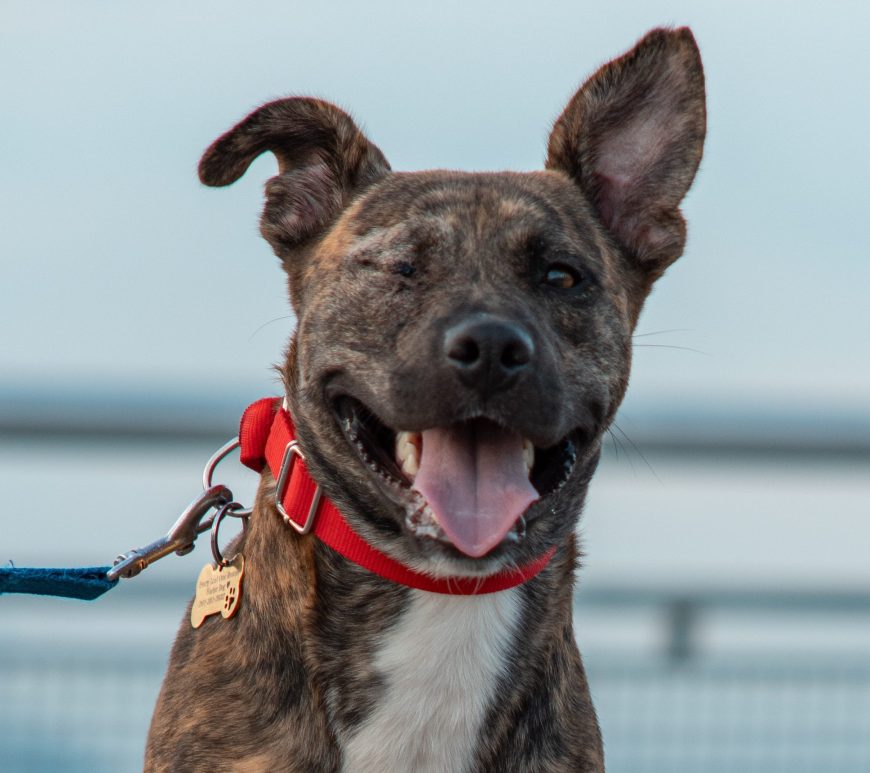
We adopted him in July. A one-eyed mutt, black and brown brindle, with velvet ears and an improbable story: from the streets of a small Louisiana town, dodging cars and hunger, to a bougie Brooklyn apartment. He came bearing a squinty marker of injury and an undiminished capacity for love.

But for all his goodness, and he is in fact the goodest boy, Tatum is not easy. He is 46 pounds and believes he is a lap dog. He sometimes cries in his sleep. He careens into you with the force of a Mack truck when you return to the apartment, even if you’ve only stepped outside to take out the trash. His favorite meals are all of them, including yours and whatever he finds on the street. His missing eye robs him of depth perception, so he misreads the world. Shadows leap, shapes blur, and danger flickers at every edge. He barks at wind, cars, strangers, a stray plastic bag blowing down the block. He is reactive, alert.

Which is how I’ve been living, too.

For two years, and longer, if I’m being honest, I’ve been scanning the horizon for danger, heart rate spiking at shadows. Misreading the benign as catastrophic. Jumping to conclusions. I see phantom threats in corners. I tremble in fear anticipating the worst possible outcome. I vacillate between too much trust and retreat. Always on the defensive.

We are walking the same path, Tatum and me. Just on opposite ends of the leash.

Every morning, at sunrise, Tatum and I walk. The city is hushed then, half-asleep, forgiving. We walk to the pier by our house, where the river flows sometimes steel sometimes slate sometimes silver. I breathe more easily there, I am always more at ease near water. He does too. He lifts his nose, taking in the damp air, tail wagging with happiness.

These walks have become liturgy. Every morning, my feet in sturdy walking shoes, his paws on concrete, we begin again. No matter what nightmares came before, no matter what fears will come later, we start with water and sky. We stand there together, two beings who have both misjudged shadows, relearning the difference between safety and threat.

Sometimes I talk to him, quietly, two friends. I tell him what’s on my mind—how frightened I’ve been, how tired I am, how grateful, too. He listens. Sometimes he presses close, leaning his weight against me, sighing as though to say, I know, me too.

We practice together. I coax him to stand still as the stroller passes. I feed him treats when the bicycle whooshes by. I remind him, again and again, that he is safe. And when I am the one who cannot calm down, when I am the one who startles at the sound of the phone or feels a cold dread at sudden silence in the house, he reminds me to sit down. He lets me pull him close. He rests his head on my lap. I let his quiet presence ground me.

There are days he surprises me. He approaches a strange dog with tail wagging, seeking connection, seeking the pack. There are other days when he cannot leave the block, when his body stiffens and he trembles as though the entire city is conspiring against him. On those days I kneel, rub the patch of fur between his ears, and whisper that I am here. That we’ll get through this. That I believe in him.

Healing, much like falling apart, it turns out, takes time. It is a dog who sleeps at your feet, sometimes whimpering. It is your husband questioning the choices of contestants on Great British Bakeoff. It is your daughter sending you pictures of her outfit from her dorm room in a different city where she is thriving. It is your own body keening in the shower, demanding you accept the truth you have kept hidden for so long.

I don’t know how long it will take, for either of us, to fully settle. But I know this. Tatum looks at me with his one good eye, and in that gaze is everything I need to remember. Life is not the worst things that happen to you. Sweetness survives. Even if you’ve lost parts of yourself along the way, you can still see what is good and true.

He is my medicine dog. Together, we are making our way forward, one step, one leash tug, one shared breath at a time.